Red Hat OpenStack HCI Targets Telco Hybrid Cloud, 5G Deployments
 The hyperconverged platform combines Red Hat OpenStack Platform 13 and Red Hat Ceph Storage 3 into one product.
The hyperconverged platform combines Red Hat OpenStack Platform 13 and Red Hat Ceph Storage 3 into one product.
 In this interview with Lavelle Networks CEO Shyamal Kumar he shares his views on SD-WAN and how Lavelle has incorporated some of the principles of B4 to create a pure networking software solution.
On May 16, the Senate passed a Congressional Review Act (CRA) to overturn the Federal Communication Commission’s (FCC) repeal of the 2015 Open Internet Order. A CRA allows Congress to review regulations issued by government agencies and overrule them with a majority vote. This vote, led by Senator Ed Markey (D-MA), is a step towards reinstating the FCC’s 2015 net neutrality rules.
The CRA will now move to the House, where it will require a majority vote in order to pass before heading to President Trump’s desk for his signature. If the CRA passes the House and gets the President’s signature, the 2015 Order will be reinstated.
Despite the CRA’s success in the Senate, it is unlikely that it will pass the House. In the Senate, every Democrat, two Independents, and three Republicans were needed to pass the CRA. In the House, Democrats hold just 193 of 435 seats and would need to be joined by 25 Republican or Independent Representatives to move the CRA to the President’s desk. Even then, the bill would face another major hurdle, as President Trump has previously expressed support for overturning the FCC’s Open Internet Order.
This is not to mention the court cases Continue reading
Pica8 makes it first steps into network automation in a unique fashion with apps for its PicOS NOS. PicaFabric build a virtual switch chassis from an leaf/spine switch clister. The PicaPilot app builds vitual switch stack for fat tree L2 everywhere campus networks. All this is done with open hardware that you can mix & […]
The post BiB 42 – Pica8 Releases PicaPilot and PicaFabric appeared first on Packet Pushers.
Central Asia, the most remote landlocked mountainous region in the world, has some of the most expensive Internet in global comparison. The cost of it can easily reach 10-20% of average monthly salary. In absolute terms, the price of the Internet can reach triple digits for 1 Mbps.
Acknowledging such challenges and considering the benefits that the Internet can bring, Central Asian governments are embarking on national digitalization strategies. The Kyrgyz Republic has launched a national program on digital transformation “Taza Koom” (“Transparent Society”). The program focuses on building an open government and a digital economy.
When it comes to digital development strategies, cooperation among countries is a mutually beneficial approach. To foster such collaboration, Cambridge University initiated a common platform called Digital Dialogue for Central Asia. The first meeting of this platform Making Inroads into Digital Transformation took place in Astana in April 2018.
Speaking at the forum on behalf of the Internet Society’s Kyrgyz Chapter, I proposed to jointly build the Digital Silk Road guided by the slogan: “free movement of ideas, people, creativity, technology and innovation”. Central Asia, with its favourable geographical location in Eurasia, could become the connecting host and focal point – a Continue reading
Networking engineers familiar with Junos love to tell me how easy it is to configure and operate IBGP EVPN overlay on top of EBGP IP underlay. Krzysztof Szarkowicz was kind enough to send me the (probably) simplest possible configuration (here’s another one by Alexander Grigorenko)
To learn more about EVPN technology and its use in data center fabrics, watch the EVPN Technical Deep Dive webinar.
Read more ...SafeKeeper: protecting web passwords using trusted execution environments Krawiecka et al., WWW’18
(If you don’t have ACM Digital Library access, the paper can be accessed either by following the link above directly from The Morning Paper blog site, or from the WWW 2018 proceedings page).
Today’s paper is all about password management for password protected web sites / applications. Even if we assume that passwords are salted and hashed in accordance with best practice (NIST’s June 2017 digital identity guidelines now mandate the use of keyed one-way functions such as CMAC), an adversary that can obtain a copy of the back-end database containing the per-user salts and the hash values can still mount brute force guessing attacks against individual passwords.

SafeKeeper goes a lot further in its protection of passwords. What really stands out is the threat model. SafeKeeper keeps end user passwords safe even when we assume that an adversary has unrestricted access to the password database. Not only that, the adversary is able to modify the content sent to the user from the web site (including active content such as client-side scripts). And not only that! The adversary is also able to read all Continue reading
 Many of the groups working on edge computing are associated with telco networking. But edge computing is definitely not limited to telco networks.
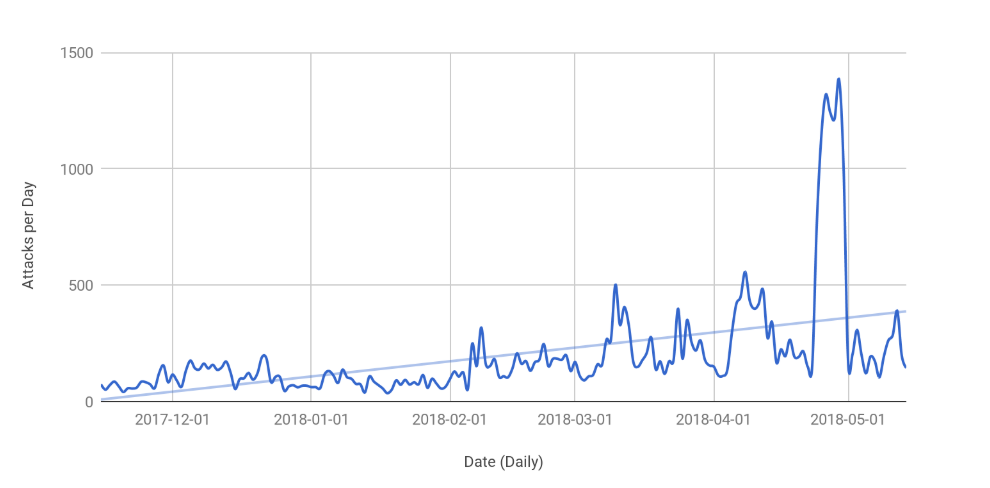
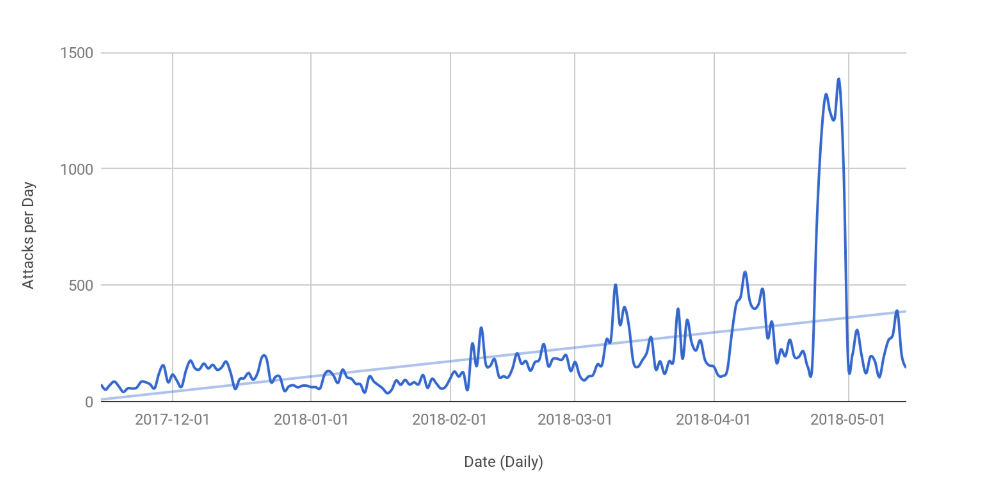
With more and more platforms taking the necessary precautions against DDoS attacks like integrating DDoS mitigation services and increasing bandwidth at weak points, Layer 3 and 4 attacks are just not as effective anymore. For Cloudflare, we have fully automated Layer 3/4 based protections with our internal platform, Gatebot. In the last 6 months we have seen a large upward trend of Layer 7 based DDoS attacks. The key difference to these attacks is they are no longer focused on using huge payloads (volumetric attacks), but based on Requests per Second to exhaust server resources (CPU, Disk and Memory). On a regular basis we see attacks that are over 1 million requests per second. The graph below shows the number of Layer 7 attacks Cloudflare has monitored, which is trending up. On average seeing around 160 attacks a day, with some days spiking up to over 1000 attacks.
A year ago, Cloudflare released Rate Limiting and it is proving to be a hugely effective tool for customers to protect their web applications and APIs from all sorts of attacks, from “low and slow” DDoS attacks, through to bot-based attacks, such as credential stuffing and content scraping. We’re pleased about the Continue reading