We have school holidays this week, so I’m reposting wonderful comments that would otherwise be lost somewhere in the page margins. Today: Dmitry Perets on the interactions between BFD and GR.
Well, assuming that the C-bit is set honestly (will be funny if not) and assuming that the Helper is using this bit correctly (and I think it’s pretty well defined what “correctly” means - see section 4.3 in RFC 5882), the answer is pretty clear.
We have school holidays this week, so I’m reposting wonderful comments that would otherwise be lost somewhere in the page margins. Today: Dmitry Perets on the interactions between BFD and GR.
Well, assuming that the C-bit is set honestly (will be funny if not) and assuming that the Helper is using this bit correctly (and I think it’s pretty well defined what “correctly” means - see section 4.3 in RFC 5882), the answer is pretty clear.
GigaOm placed VMware Tanzu Service Mesh (TSM) in the leader ring of its 2021 GigaOm Radar Report for Evaluating Service Mesh, cementing VMware’s status as the open-source choice for connecting and securing modern applications across single and multi-cloud environments.
As enterprises continue to split applications into microservices that can be spun up or down as needed, service meshes give DevOps the ability to seamlessly and simply orchestrate connectivity and security services across multi-cloud environments, automatically and at scale. This common abstraction layer for application services enables true app resiliency, observability, and security across single and multi-cloud environments — a critical superpower for organizations focused on delivering powerful and consistent experiences.
VMware continues to lead
Citing Tanzu Service Mesh’s open-source architecture, dominance in the enterprise market, innovative road map, and focus on improving security, the authors of the report feel that Tanzu Service Mesh gives enterprises the best chance of gaining that all-important visibility and control with modern applications.
The key to this, of course, is Tanzu Service Mesh’s ability to seamlessly abstract the application layer from the infrastructure layer through Global Namespace (GNS). By onboarding applications to a Global Namespace, developers, operations, and security gain consistent policy controls and operational Continue reading
Aruba Networks has collected customer best practices and guidance on what it takes for a successful SD-WAN implementation. Those stories and best practices have been captured in a new eBook from Aruba, available now.
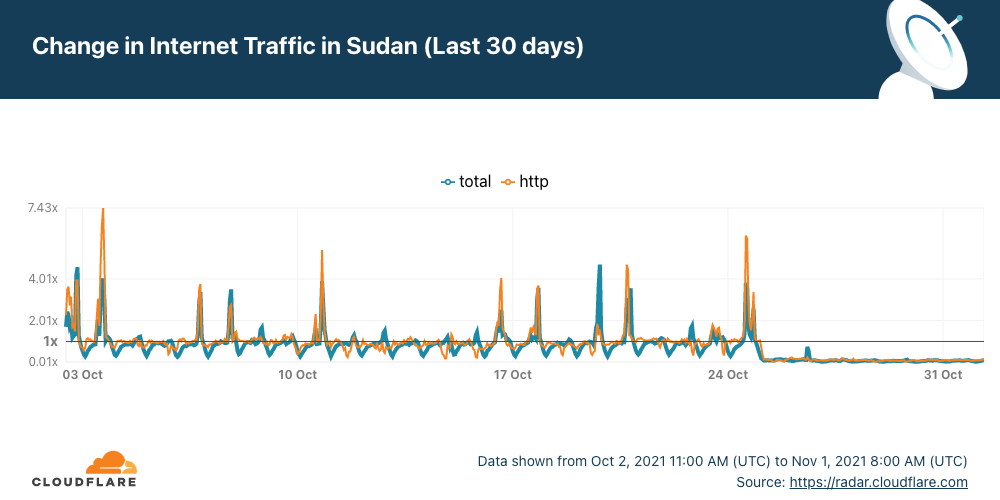
Today, October 25, following political turmoil, Sudan woke up without Internet access.
In our June blog, we talked about Sudan when the country decided to shut down the Internet to prevent cheating in exams.
Now, the disruption seems to be for other reasons. AP is reporting that "military forces ... detained at least five senior Sudanese government figures.". This afternoon (UTC) several media outlets confirmed that Sudan's military dissolved the transitional government in a coup that shut down mobile phone networks and Internet access.
Cloudflare Radar allows anyone to track Internet traffic patterns around the world. The dedicated page for Sudan clearly shows that this Monday, when the country was waking up, the Internet traffic went down and continued that trend through the afternoon (16:00 local time, 14:00 UTC).
We dug in a little more on the HTTP traffic data. It usually starts increasing after 06:00 local time (04:00 UTC). But this Monday morning, traffic was flat, and the trend continued in the afternoon (there were no signs of the Internet coming back at 18:00 local time).
When comparing today with the last seven days' pattern, we see that today's drop is abrupt and unusual.
Today on the Tech Bytes podcast we’re talking about how to get cloud agility on premises. Our sponsor is Pluribus Networks, which makes data center SDN software. They’ve brought along partner ITRenew, which specializes in providing high-performance rack-level infrastructure. We talk about how Pluribus and ITRenew come together to deliver a private cloud.
The Kubernetes Cluster API (CAPI) project—which recently released v1.0—can, if you wish, help manage the underlying infrastructure associated with a cluster. (You’re also fully able to have CAPI use existing infrastructure as well.) Speaking specifically of AWS, this means that the Cluster API Provider for AWS is able to manage VPCs, subnets, routes and route tables, gateways, and—of course—EC2 instances. These EC2 instances are booted from a set of AMIs (Amazon Machine Images, definitely pronounced “ay-em-eye” with three syllables) that are prepared and maintained by the CAPI project. In this short and simple post, I’ll show you how to influence the AMI selection process that CAPI’s AWS provider uses.
There are a couple different ways to influence AMI selection, and all of them have to do with settings within the AWSMachineSpec, which controls the configuration of an AWSMachine object. (An AWSMachine object is an infrastructure-specific implementation of a logical Machine object.) Specifically, there are these options for influencing AMI selection:
You can instruct CAPI to use a specific AMI with the ami field. (If this field is set, the other options do not apply.)
This week on the Network Break podcast we discuss a new ToR switch from Aruba that includes built-in silicon to offload security and network services. Dell Technologies says the VMware spin-off will be complete by November 1st, and SASE startup Cato Networks raises $250 in an F round of funding.
Open RAN is a push for industry standards in the design of gear that’s used in the radio-access segment of telecom cellular networks and is particularly relevant to the buildout of 5G infrastructure.
5G resources
What is 5G? Fast wireless technology for enterprises and phones
How 5G frequency affects range and speed
Private 5G can solve some problems that Wi-Fi can’t
Private 5G keeps Whirlpool driverless vehicles rolling
5G can make for cost-effective private backhaul
CBRS can bring private 5G to enterprises
Radio-access networks (RAN) serve to connect the base stations that transmit and receive traffic to from endpoints like cell phones and laptops and provide the link toward the carrier core network.To read this article in full, please click here
There are several service mesh products and projects today, promising simplified connectivity between application microservices, while at the same time offering additional capabilities like secured connections, observability, and traffic management. But as we’ve seen repeatedly over the last few years, the excitement about service mesh has been tempered by practical additional overhead. Let’s explore how Envoy or wrote about his experiences configuring Istio to reduce consumption from around 1GB per proxy (!) to a much more reasonable 60-70MB each. But even in our Continue reading
When it comes to Amazon Web Services (AWS) infrastructure automation, the latest release of the Ansible amazon.aws Collection brings a set of fresh features to build, manage and govern various public and hybrid cloud use cases while accelerating the process from development to production.
In this blog post, we will go over what else has changed and highlight what’s new in the 2.0 release of this Ansible Content Collection.
Forward-looking Changes
Much of our work in the 2.0 release has been focused in the following areas:
Enhancing several modules from the upstream community
Promoting modules to being formally supported by Red Hat
Releasing various new enhancements and clarifying supportability policies
New boto3/botocore Support Policy
Starting with the 2.0 amazon.aws Collection release, it is now the Collection’s policy to support the versions of botocore and boto3 that were released 12 months prior to the most recent major Collection release, as well as following semantic versioning (for example, 2.0.0, 3.0.0). Individual modules may require a more recent library version to support specific features or require the boto library. Check the amazon.aws Collection documentation for the minimum required version for each module. Continue reading
A big part of the job of a technical writer is getting feedback on the content you produce. Writing and maintaining product documentation is a deeply collaborative and cyclical effort — through constant conversation with product managers and engineers, technical writers ensure the content is clear and serves the user in the most effective way. Collaboration with other technical writers is also important to keep the documentation consistent with Cloudflare’s content strategy.
So whether we’re documenting a new feature or overhauling a big portion of existing documentation, sharing our writing with stakeholders before it’s published is quite literally half the work.
In my experience as a technical writer, the feedback I’ve received has been exponentially more impactful when stakeholders could see my changes in context. This is especially true for bigger and more strategic changes. Imagine I’m changing the structure of an entire section of a product’s documentation, or shuffling the order of pages in the navigation bar. It’s hard to guess the impact of those changes just by looking at the markdown files.
We writers check those changes in context by building a development server on our local machines. But sharing what we see locally with our stakeholders has Continue reading
A few weeks ago I asked my subscribers which webinar they’d like to see in November (thanks a million to everyone who replied!). Not surprisingly, network automation got the top spot, but I was a bit sad to see my long-term pet project at the bottom of the list:
1st Post Comparing Open Source BGP Stacks 2nd Post Follow-up Measuring BGP Stacks Performance 3rd Post Comparing Open Source BGP stacks with internet routes 4th Post Bird on Bird, Episode 4 of BGP Perf testing In the 3rd post I compared these open source BGP stacks with up to 50...
One of the most important classic sci-fi stories is the book "Dune" from Frank Herbert. It was recently made into a movie. I thought I'd write a quick review.
The summary is this: just read the book. It's a classic for a good reason, and you'll be missing a lot by not reading it.
But the movie Dune (2021) movie is very good. The most important thing to know is see it in IMAX. IMAX is this huge screen technology that partly wraps around the viewer, and accompanied by huge speakers that overwhelm you with sound. If you watch it in some other format, what was visually stunning becomes merely very pretty.
This is Villeneuve's trademark, which you can see in his other works, like his sequel to Bladerunner. The purpose is to marvel at the visuals in every scene. The story telling is just enough to hold the visuals together. I mean, he also seems to do a good job with the story telling, but it's just not the reason to go see the movie. (I can't tell -- I've read the book, so see the story differently than those of you who haven't).