Container Approach to Boosting GPU Utilization Secures Bigger Backing
Getting peak utilization out of GPU farms in the age of AI will be the unending quest. …
Container Approach to Boosting GPU Utilization Secures Bigger Backing was written by Nicole Hemsoth at The Next Platform.
New Docker and JFrog Partnership Designed to Improve the Speed and Quality of App Development Processes
Today, Docker and JFrog announced a new partnership to ensure developers can benefit from integrated innovation across both companies’ offerings. This partnership sets the foundation for ongoing integration and support to help organizations increase both the velocity and quality of modern app development.
The objective of this partnership is simple: how can we ensure developers can get the images they want and trust, and make sure they can access them in whatever development process they are using from a centralized platform? To this end, the new agreement between Docker and JFrog ensures that developers can take advantage of their Docker Subscription and Docker Hub Official Images in their Artifactory SaaS and on-premise environments so they can build, share and run apps with confidence.
At a high level, a solution based on the Docker and JFrog partnership looks like this:

In this sample architecture, developers can build apps with images, including Docker Official Images and images from popular OSS projects and software companies, from Docker Hub. As images are requested, they are cached into JFrog Artifactory, where images can be managed by corporate policies, cached for high performance, and mirrored across an organization’s infrastructure. Also, the images in Artifactory can take Continue reading
Fixing XML-to-JSON Conversion Challenges
In the last weeks I described the challenges you might face when converting XML documents that contain lists with a single element into JSON, be it on device (Nexus OS) or in an Ansible module. Now let’s see how we can fix that.
Blog posts in this series
- Beware XML-to-JSON Information Loss (Junos with Ansible)
- XML-to-JSON Information Loss, Cisco Nexus OS Edition
- Fixing XML-to-JSON Conversion Challenges (this post)
Fixing XML-to-JSON Conversion Challenges
In the last weeks I described the challenges you might face when converting XML documents that contain lists with a single element into JSON, be it on device (Nexus OS) or in an Ansible module. Now let’s see how we can fix that.
Blog posts in this series
- Beware XML-to-JSON Information Loss (Junos with Ansible)
- XML-to-JSON Information Loss, Cisco Nexus OS Edition
- Fixing XML-to-JSON Conversion Challenges
After Three Decades, You Can Finally Have A Distributed SQL Database
Without good technology, all the marketing in the world won’t get a company off the ground and keep it in the air, and conversely, without good marketing and sales, all of the technology in the world won’t do it, either. …
After Three Decades, You Can Finally Have A Distributed SQL Database was written by Timothy Prickett Morgan at The Next Platform.
Elixir Notes: Variables
Define a variable in Elixir with the equals (=) operator. Considerations Variables can start with a lowercase [a-z] or an underscore _ Variables can contain upper/lower case [a-zA-Z] and the _ underscore characters. snake_case is the formatting convention used for...My List of Unusual Things in DNS
This is a running list of unusual data found in the Domain Name System.
Typically, DNS stores name-to-IP (for example, foo.example.net -> 192.0.2.123) and IP-to-name mappings (i.e., the inverse). But, the
DNS is arguably the biggest, most distributed key/value store on the planet,
making it a great place to stash all kinds of simple data.
Elixir Using Mix To Create A Package
How to create and Elixir package with Mix.The Week in Internet News: Google Threatens to Leave Australia

Google won’t pay for news: Google has threatened to end its search engine services in Australia over the government’s efforts there to require the company to pay news publishers for articles it links to, the BBC reports. The proposed Australian news code would require Google and Facebook to enter into mediated negotiations with publishers over the value of news content, if they don’t reach agreement first.
RIP, balloon-based Internet: Alphabet, Google’s parent company, is shutting down Loon, its attempt to deliver Internet service through balloons floating in the stratosphere, CNet reports. Alphabet says the business model doesn’t work, with the company unable to get costs low enough to offer services.
Judge rejects Parler: A U.S. judge has ruled that Amazon doesn’t have to reinstate Parler, the conservative Twitter competitor, after the company kicked it off its web hosing services this month, NPR reports. Amazon kicked out Parler after some members of the site threatened U.S. lawmakers and allegedly used the service to plan the 6 January attack on the U.S. Capitol. Parler has argued that Amazon’s decision threatens it with “extinction,” but the judge ruled that Amazon is under no obligation to “host the incendiary speech that Continue reading
New Docker Reporting Provides Teams with Tools for Higher Efficiency and Better Collaboration
Today, we are very excited to announce the release of Audit Log, a new capability that provides the administrators of Docker Team subscription accounts with a chronological report of their team activities. The Audit Log is an unbiased system of record, displaying all the status changes for Docker organizations, teams, repos and tags. As a tracking tool for all the team activities, it creates a central historical repository of actionable insights to diagnose incidents, provide a record of app lifecycle milestones and changes, and provides a view into events creating audit trails for regulatory compliance reviews. The Audit Log is available for Team subscription accounts, and at this point, is not included with Free or Pro subscriptions.
Some typical scenarios where Audit Log will play a key role include:
- When several team members are collaborating on delivering a project, Audit Log creates a list of activities that becomes a ‘source of truth’ to validate which tags got deleted and which tags got pushed into repos, when these activities happened and which team members triggered them.
- Audit Log provides knowledge base continuity, delivering information on projects completed earlier when new team members need to familiarize themselves with work done Continue reading
Tech Bytes: Doing Better Than ‘Good’ Or ‘Bad’ For UX Metrics (Sponsored)
On today's Tech Bytes podcast, sponsored by AppNeta, we talk about getting real-time monitoring in place so that you can clearly define your performance benchmarks, accurately measure them from the end-user perspective, and have a strategy to make sure those benchmarks are met. Our guests are John Tewfik, Director of Global Alliances; and Seth Differ, Senior Manager, Solutions Consulting.Tech Bytes: Doing Better Than ‘Good’ Or ‘Bad’ For UX Metrics (Sponsored)
On today's Tech Bytes podcast, sponsored by AppNeta, we talk about getting real-time monitoring in place so that you can clearly define your performance benchmarks, accurately measure them from the end-user perspective, and have a strategy to make sure those benchmarks are met. Our guests are John Tewfik, Director of Global Alliances; and Seth Differ, Senior Manager, Solutions Consulting.
The post Tech Bytes: Doing Better Than ‘Good’ Or ‘Bad’ For UX Metrics (Sponsored) appeared first on Packet Pushers.
Focus is a Virtue
The modern world craves our attention—but only in short bursts. To give your attention to any one thing for too long is failing, it seems, because you might miss out on something else of interest. We have entered the long tail of the attention economy, grounded in finding every smaller slices of time in which the user’s attention can be captured and used.
The problem is obvious for anyone with eyes to see. What is the solution? The good news is there are solutions. The bad news is these solutions are swimming upstream against the major commercial interests of our day, so it’s going to Continue reading
Sponsored Post: 3T, Bridgecrew, Toptal, IP2Location, Ipdata, StackHawk, InterviewCamp.io, Educative, Triplebyte, Stream, Fauna

Who's Hiring?
- Looking to rapidly hire Top Software Developers? Get Started with Toptal. Toptal will match you with top-quality, pre-screened freelance software developers that meet your project requirements. All in under 48 hours. Get started right away with a no risk trial.
- InterviewCamp.io has hours of system design content. They also do live system design discussions every week. They break down interview prep into fundamental building blocks. Try out their platform.
- Triplebyte lets exceptional software engineers skip screening steps at hundreds of top tech companies like Apple, Dropbox, Mixpanel, and Instacart. Make your job search O(1), not O(n). Apply here.
- Need excellent people? Advertise your job here!
Cool Products and Services
- Discover the MongoDB data masking tool in Studio 3T Enterprise. Enable data compliance and bolster security with powerful field-level data obfuscation. Try for free!
- Bridgecrew is the cloud security platform for developers. By leveraging automation and delivering security-as-code, Bridgecrew empowers teams to find, fix, and prevent misconfigurations in deployed cloud resources and in infrastructure as code. Get started for free!
- IP2Location is IP address geolocation service provider since 2002. The geolocation database or API detects location, proxy and other >20 parameters. Continue reading
UK Startup Funded to Create End-All OS for Quantum Computing
The 2010s provided a range of new quantum hardware makers to evaluate but the 2020s will be focused far more software for broader use of nascent quantum devices. …
UK Startup Funded to Create End-All OS for Quantum Computing was written by Nicole Hemsoth at The Next Platform.
Topology
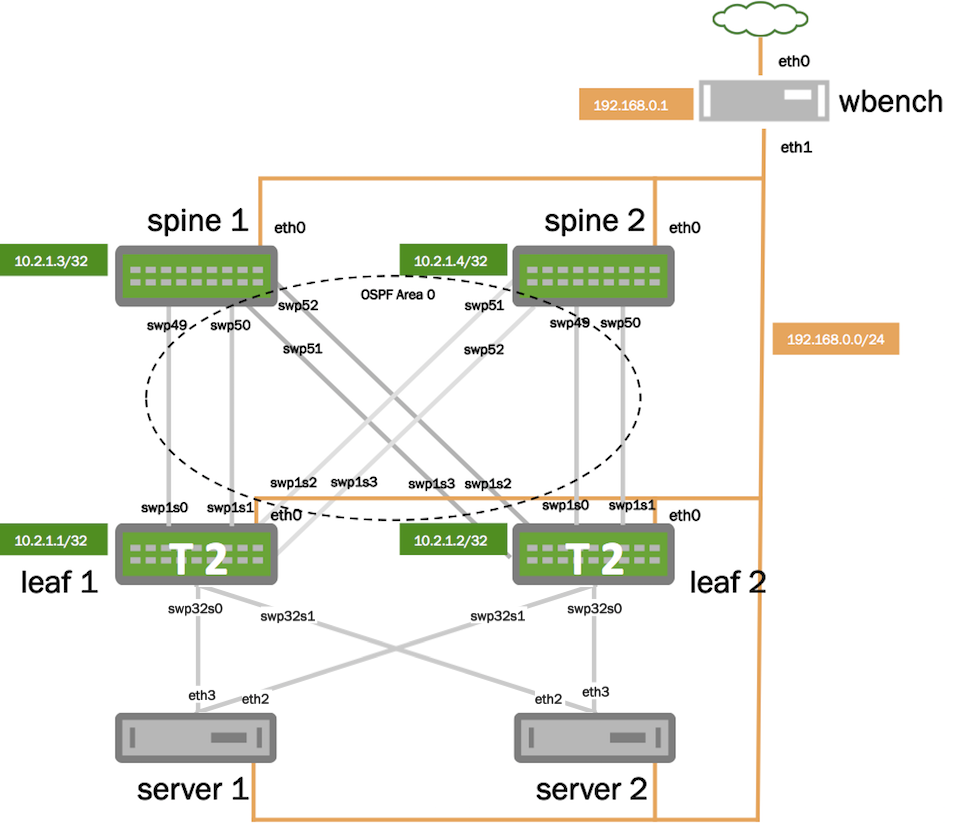
Real-time network and system metrics as a service describes how to use data captured from the network shown above to explore the functionality of sFlow-RT real-time analytics software. This article builds on the previous article to show how knowledge of network topology can be used to enhance analytics, see Topology for documentation.
First, follow the instructions in the previous example and start an instance of sFlow-RT using the captured sFlow.
curl -O https://raw.githubusercontent.com/sflow-rt/fabric-view/master/demo/topology.jsonThen, download the topology file for the example.
curl -X PUT -H "Content-Type: application/json" -d @topology.json \Install the topology using the sFlow-RT REST API.
http://localhost:8008/topology/json
curl http://localhost:8008/topology/jsonRetrieve the topology.
{
 "version": 0,
 "links": {
  "L1": {
   "node2": "spine1",
   "node1": "leaf1",
   "port1": "swp1s0",
   "port2": "swp49"
  },
  "L2": {
   "node2": "spine1",
   "node1": "leaf1",
   "port1": "swp1s1",
   "port2": "swp50"
  },
  "L3": {
   "node2": "spine2",
   "node1": "leaf1",
   "port1": "swp1s2",
   "port2": "swp51"
  },
  "L4": {
   "node2": "spine2",
   "node1": "leaf1",
   "port1": "swp1s3",
   "port2": "swp52"
  },
  "L5": {
   "node2": "spine2",
   "node1": "leaf2",
   "port1": "swp1s0",
   "port2": "swp49"
  },
  "L6": {
   "node2": "spine2",
   "node1": "leaf2",
   "port1": "swp1s1",
   "port2": "swp50"
  },
  "L7": {
   "node2": "spine1",
   "node1": "leaf2",
   "port1": "swp1s2",
   "port2": "swp51"
  },
  "L8": {
   "node2": "spine1",
   "node1": "leaf2",
   "port1": "swp1s3",
   "port2":  Continue reading