The Apple iPhone 12 has 5G but its not for customers. Its because the mobile co’s wanted it. And they indirectly paid Apple for it. While its true that 5G increases bandwidth and reduces latency, it more important that it reduces infrastructure costs. Alert: This twitter thread is a trial of the “blog post as […]
The idea of redistributing the full Internet routing table (840.000 routes at this moment) into OSPF sounds as ridiculous as it is, but when fat fingers strike, it should be relatively easy to recover, right? Just turn off redistribution (assuming you can still log into the offending device) and move on.
The idea of redistributing the full Internet routing table (840.000 routes at this moment) into OSPF sound as ridiculous as it is, but when fat fingers strike it should be relatively easy to recover, right? Just disable redistribution (assuming you can still log into the offending device) and move on.
In the previous article we have mentioned that we have started building our own Python package, which will allow you to easily interact with the network functions over gNMI. Today we want to share with you some progress and explain, how you can start benefiting from it right now.
1
2
3
4
5
No part of this blogpost could be reproduced, stored in a

retrieval system, or transmitted in any form or by any

means, electronic, mechanical or photocopying, recording,

or otherwise, for commercial purposes without the

prior permission of the author.
Is automation really so important?
Amount of network-related tasks in each company is growing years, if company is doing well. The number of employees is not. That creates a need for business relying on technologies to “do more with less”. The automation is a key enabler for this approach. And we are keen to help your business (or yourself) to find a right approach to network automation and successfully implement it. In our trainings:
We explain the advantages and challenges of network automation in multivendor networks.
We teach you how to reach quick wins in network automation to fuel your automation projects for Continue reading
Who would have imagined that there’s a Linux tool available for downloading YouTube videos? Well, there is and it works for Linux as well as for other operating systems. So, if you need to watch some of the available videos even when your internet connection is flaky or you need to be offline for a while, this tool can be especially handy.The tool for downloading videos is called youtube-dl. (The “dl” portion undoubtedly means “download”.) It’s very easy to use and drops webm or mp4 files onto your system. Both formats provide compressed, high-quality video files that you can watch whenever you like.To read this article in full, please click here
The move to integrating AI into current operations and finding its role in entirely new applications at Royal Bank of Canada (RBC) is similar to what we’re seeing among other large-scale enterprises. …
AMD had a busy week last week. It introduced the third generation of its Zen microarchitecture, which has been propelling the company’s comeback since 2017, and is the subject of reports it is looking to buy field-programmagle gate array (FPGA) maker Xilinx.Five years ago, AMD was a non-entity in the CPU market and only kept afloat by its GPU business. Intel had written the company off and considered Qualcomm its biggest competitor. Then the company came out with Zen, a whole new design. “We started with Zen from scratch, starting from a clean sheet of paper,” said CEO Lisa Su in a video announcement.The result is a nice comeback for a company that had been written off five years ago. It has 5.8% of the server market share as of Q2, 19.2% of desktop and 19.9% of mobile, according to Mercury Research, which specializes in semiconductor market share. The server share may seem low, but two years ago it was at zero and server turnover is slower than desktop.To read this article in full, please click here
AMD had a busy week last week. It introduced the third generation of its Zen microarchitecture, which has been propelling the company’s comeback since 2017, and is the subject of reports it is looking to buy field-programmagle gate array (FPGA) maker Xilinx.Five years ago, AMD was a non-entity in the CPU market and only kept afloat by its GPU business. Intel had written the company off and considered Qualcomm its biggest competitor. Then the company came out with Zen, a whole new design. “We started with Zen from scratch, starting from a clean sheet of paper,” said CEO Lisa Su in a video announcement.The result is a nice comeback for a company that had been written off five years ago. It has 5.8% of the server market share as of Q2, 19.2% of desktop and 19.9% of mobile, according to Mercury Research, which specializes in semiconductor market share. The server share may seem low, but two years ago it was at zero and server turnover is slower than desktop.To read this article in full, please click here
Although the $40 billion deal still faces long scrutiny by regulators, the reasons behind proposed acquisition of planning to buy FPGA maker Xilinx.
NVidia doesn’t plan to change Arm’s IP licensing business model, or replace its Mali GPU with NVidia technology, CEO
The HyperText Transfer Protocol (HTTP) carries the vast majority of all the traffic on the Internet today, and even the vast majority of traffic carried on private networks. How did this protocol originate, and what was the interplay between standards organizations in it’s creation, curation, and widespread deployment? Mark Nottingham joins Donald and I on this episode of the History of Networking to answer our questions.
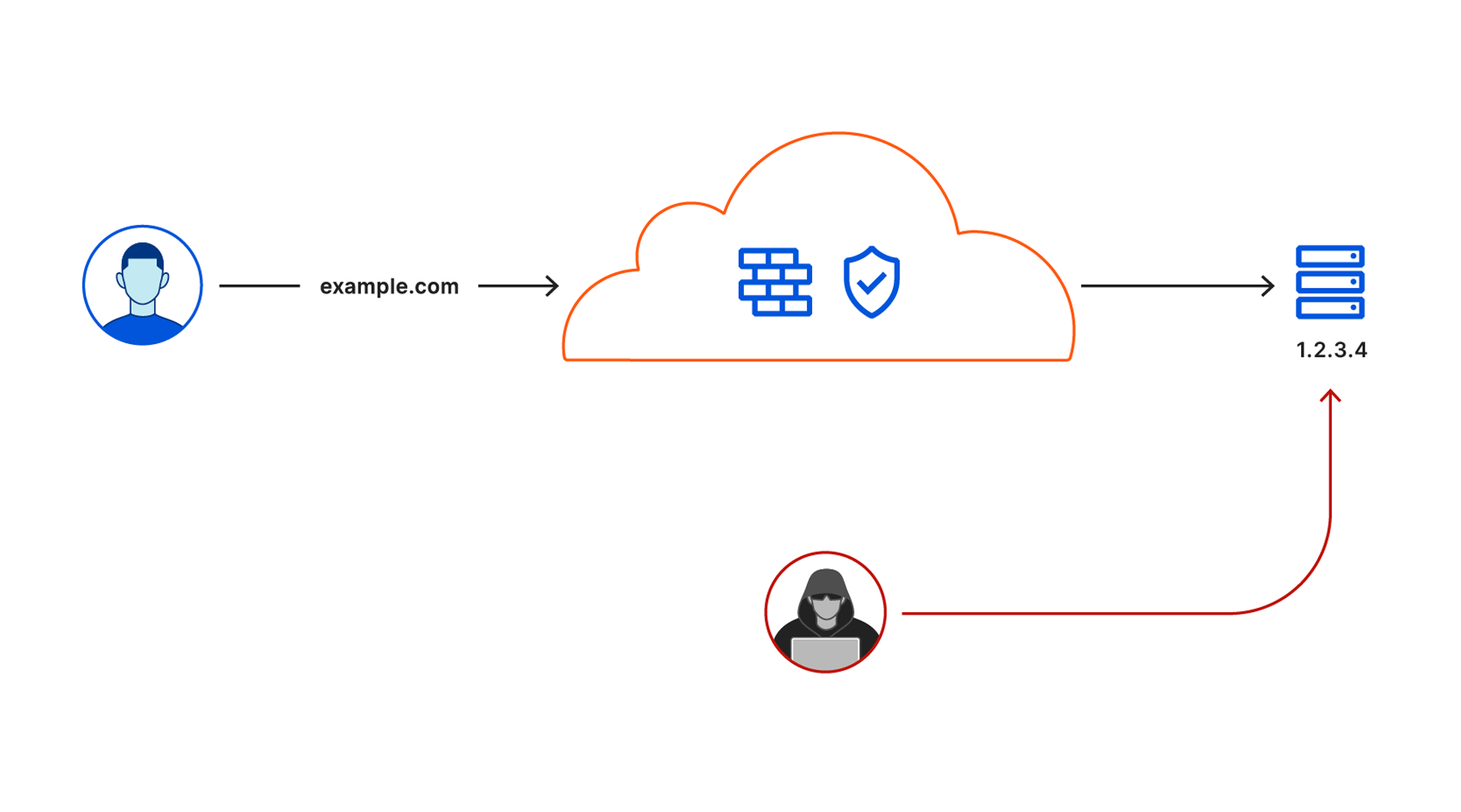
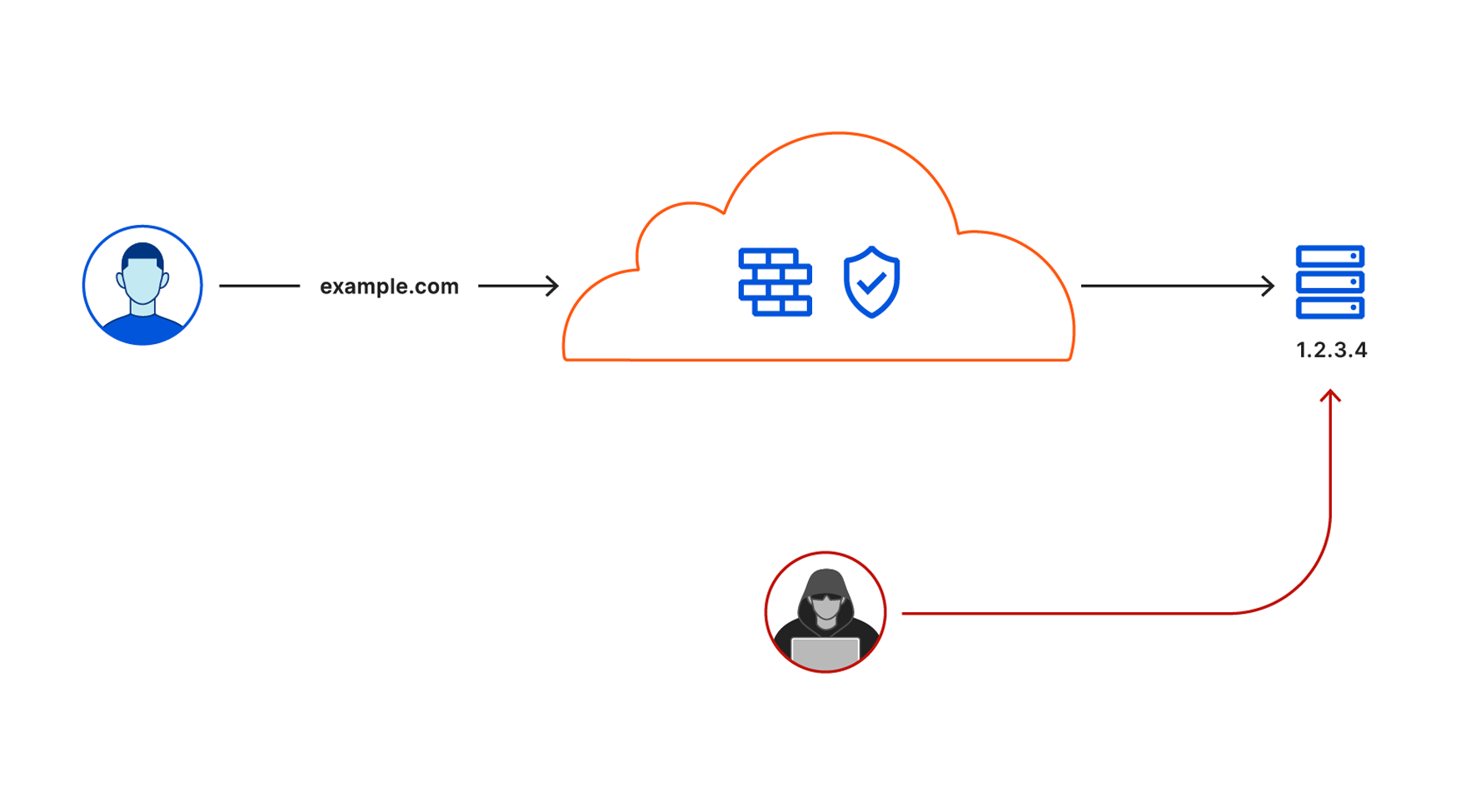
Cloudflare secures your origin servers by proxying requests to your DNS records through our anycast network and to the external IP of your origin. However, external IP addresses can provide attackers with a path around Cloudflare security if they discover those destinations.
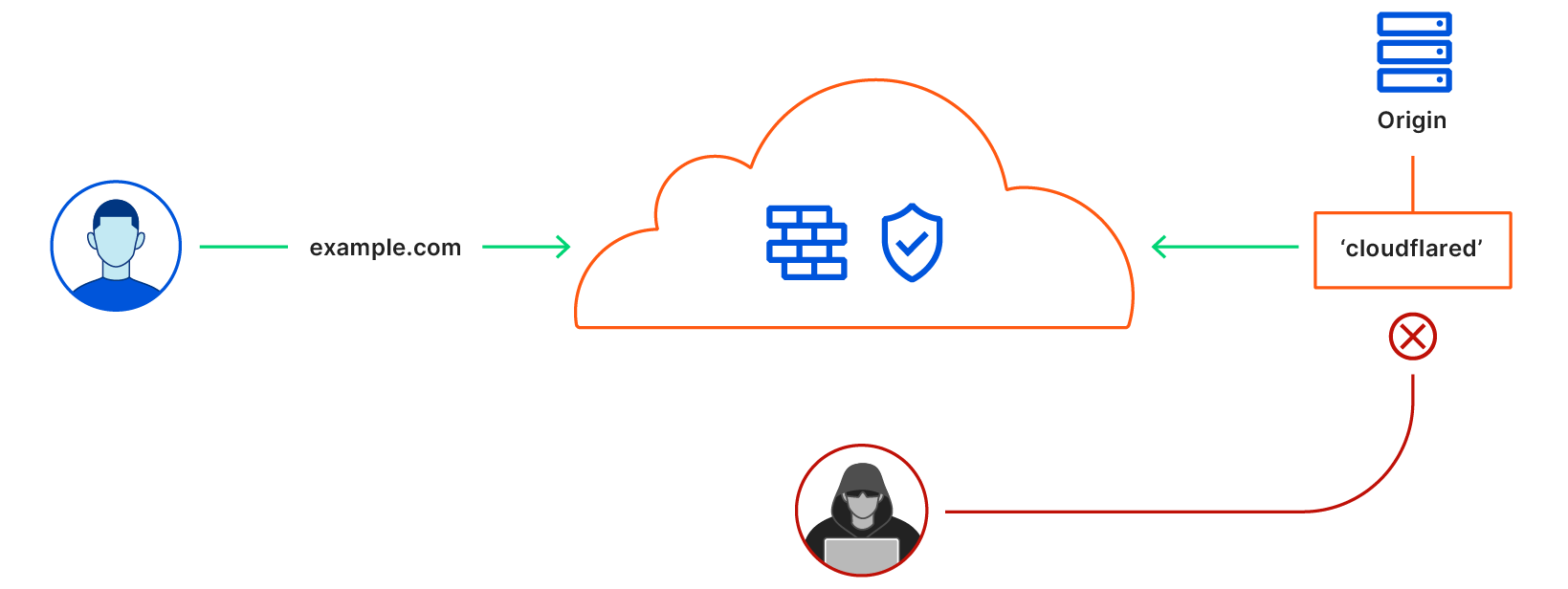
We launched Argo Tunnel as a secure way to connect your origin to Cloudflare without a publicly routable IP address. With Tunnel, you don’t send traffic to an external IP. Instead, a lightweight daemon runs in your infrastructure and creates outbound-only connections to Cloudflare’s edge. With Argo Tunnel, you can quickly deploy infrastructure in a Zero Trust model by ensuring all requests to your resources pass through Cloudflare’s security filters.
Originally, your Argo Tunnel connection corresponded to a DNS record in your account. Requests to that hostname hit Cloudflare’s network first and our edge sends those requests over the Argo Tunnel to your origin. Since these connections are outbound-only, you no longer need to poke holes in your infrastructure’s firewall. Your origins can serve traffic through Cloudflare without being vulnerable to attacks that bypass Cloudflare.
However, fitting an outbound-only connection into a reverse proxy creates some ergonomic and stability hurdles. The original Argo Tunnel architecture attempted to both Continue reading
Today's Network Break analyzes NVIDIA's new roadmap for DPUs (also known as SmartNICs), IBM's spin-out of its managed infrastructure business, new security features from Juniper, a whopping judgement against Cisco for patent violations, and more.
Today's Network Break analyzes NVIDIA's new roadmap for DPUs (also known as SmartNICs), IBM's spin-out of its managed infrastructure business, new security features from Juniper, a whopping judgement against Cisco for patent violations, and more.
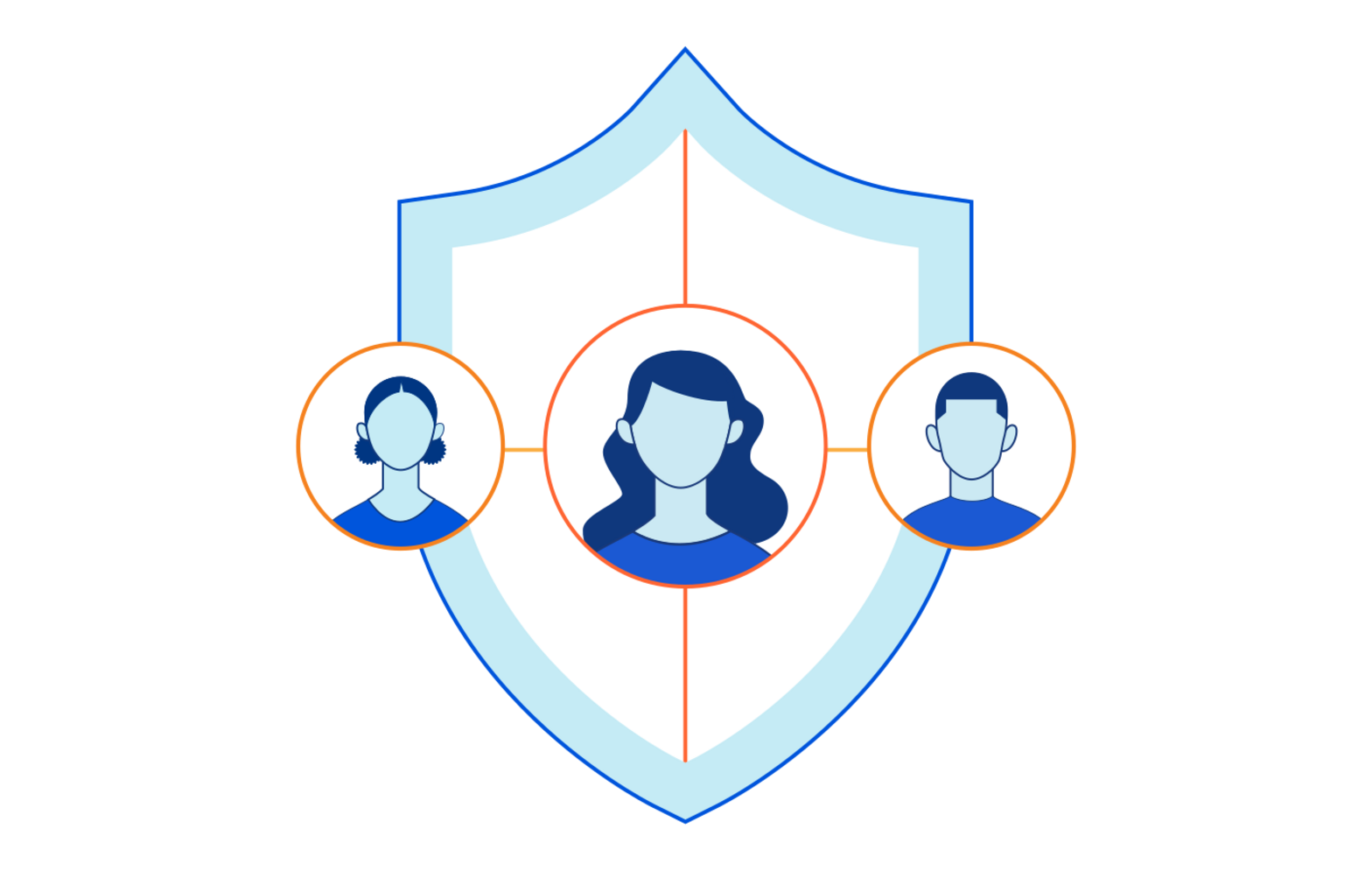
We launched Cloudflare for Teams to make Zero Trust security accessible for all organizations, regardless of size, scale, or resources. Starting today, we are excited to take another step on this journey by announcing our new Teams plans, and more specifically, our Cloudflare for Teams Free plan, which protects up to 50 users at no cost. To get started, sign up today.
If you’re interested in how and why we’re doing this, keep scrolling.
Our Approach to Zero Trust
Cloudflare Access is one-half of Cloudflare for Teams - a Zero Trust solution that secures inbound connections to your protected applications. Cloudflare Access works like a bouncer, checking identity at the door to all of your applications.
The other half of Cloudflare for Teams is Cloudflare Gateway which, as our clever name implies, is a Secure Web Gateway protecting all of your users’ outbound connections to the Internet. To continue with this analogy, Cloudflare Gateway is your organization’s bodyguard, securing your users as they navigate the Internet.
Together, these two solutions provide a powerful, single dashboard to protect your users, networks, and applications from malicious actors.
A Mission-Driven Solution
At Cloudflare, our mission is to help build a better Internet. That Continue reading
We built Cloudflare Access™ as a tool to solve a problem we had inside of Cloudflare. We rely on a set of applications to manage and monitor our network. Some of these are popular products that we self-host, like the Atlassian suite, and others are tools we built ourselves. We deployed those applications on a private network. To reach them, you had to either connect through a secure WiFi network in a Cloudflare office, or use a VPN.
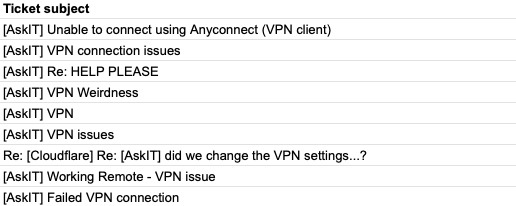
That VPN added friction to how we work. We had to dedicate part of Cloudflare’s onboarding just to teaching users how to connect. If someone received a PagerDuty alert, they had to rush to their laptop and sit and wait while the VPN connected. Team members struggled to work while mobile. New offices had to backhaul their traffic. In 2017 and early 2018, our IT team triaged hundreds of help desk tickets with titles like these:
While our IT team wrestled with usability issues, our Security team decided that poking holes in our private network was too much of a risk to maintain. Once on the VPN, users almost always had too much access. We had limited visibility into what happened on Continue reading
IT purchasing teams have a dismal track record, in part because they face a number of roadblocks. Undue influence of a few team members who only check in occasionally. Failure to include a diversity of stakeholders. Paying too much attention to what vendors say about their own products. Not giving security its due.
Tech Spotlight: IT Leadership
IT leadership lessons from CIO 100 Award winners (CIO)
How to sustain IT workplace culture — without the workplace (Computerworld)
The CISO’s newest responsibility: Building trust (CSO)
How to mandate agility in software development, operations, and data science (InfoWorld)
Tech spotlight: IT leadership lessons from the front lines in challenging times [PDF]
So what can IT pros do to improve things and ensure successful purchases when they're members of buying teams? Plenty, according to Gartner.To read this article in full, please click here
The biggest challenge we face is variable preparation and peer review process before committing variables to Git. I’d be particularly interested on how you overcome this challenge?
We spent hours describing potential solutions in Validation, Error Handling and Unit Tests part of Building Network Automation Solutions online course, but if you never built a network automation solution using Ansible YAML files as source-of-truth the above sentence might sound a lot like Latin, so let’s make it today’s task to define the problem.
 The Apple iPhone 12 has 5G but its not for customers. Its because the mobile co’s wanted it. And they indirectly paid Apple for it. While its true that 5G increases bandwidth and reduces latency, it more important that it reduces infrastructure costs. Alert: This twitter thread is a trial of the “blog post as […]