Containerlab DDoS testbed
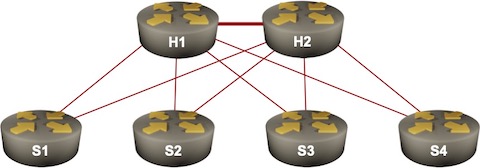
Real-time telemetry from a 5 stage Clos fabric describes lightweight emulation of realistic data center switch topologies using Containerlab. This article extends the testbed to experiment with distributed denial of service (DDoS) detection and mitigation techniques described in Real-time DDoS mitigation using BGP RTBH and FlowSpec.docker run --rm -it --privileged --network host --pid="host" \Start Containerlab.
-v /var/run/docker.sock:/var/run/docker.sock -v /run/netns:/run/netns \
-v ~/clab:/home/clab -w /home/clab \
ghcr.io/srl-labs/clab bash
curl -O https://raw.githubusercontent.com/sflow-rt/containerlab/master/ddos.ymlDownload the Containerlab topology file.
containerlab deploy -t ddos.ymlFinally, deploy the topology. Connect to the web interface, http://localhost:8008. The sFlow-RT dashboard verifies that telemetry is being received from 1 agent (the Customer Network, ce-router, in the diagram above). See the sFlow-RT Quickstart guide for more information. Now access the DDoS Protect application at http://localhost:8008/app/ddos-protect/html/. The BGP chart at the bottom right verifies that BGP connection has been established so that controls can be sent to the Customer Router, ce-router.
docker exec -it clab-ddos-attacker hping3 --flood --udp -k -s 53 192.0.2.129Start a simulated DNS amplification attack using hping3. The udp_amplification chart shows that traffic matching the attack signature has crossed the threshold. The Controls chart shows Continue reading


addresses these challenges with a holistic approach to cloud networking including both the switching fabric and the compute virtualization fabric. I then explain how the Pluribus Netvisor® ONE network operating system (OS) integrates with the NVIDIA® Bluefield® data processing unit (DPU) hardware architecture to deliver a Unified Cloud Fabric across any workload environment (including ESXi, Hyper-V, Xen, KVM, bare metal, and Kubernetes), provide a zero-trust administration model between compute and network, and radically simplify the networking stack running on the server OS with better overall performance and lower TCO. Finally, I review the initial set of use cases Pluribus is delivering with the Early Field Trial (EFT) program starting next month.